- Proudly Made in the USA

Fire door regulations vary across borders, but their purpose is consistent: to slow fire and smoke while people escape. A door is not a single product. Its leaf, frame, seals, hinges, closer, and latch must work together as a tested assembly. A small gap beneath the door can matter.
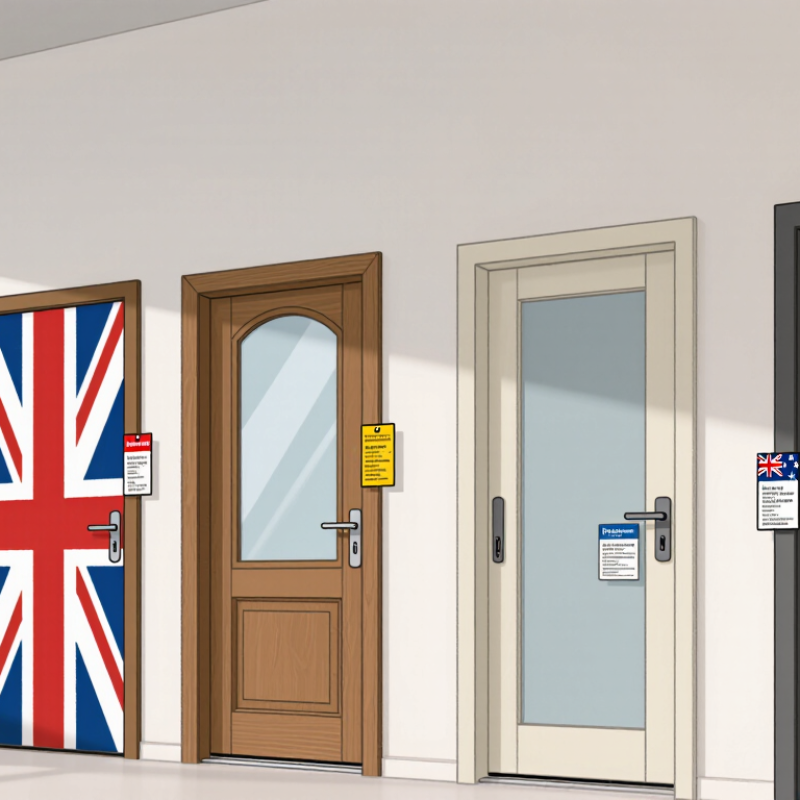
Fire-safety engineer Alex Morgan puts the practical point this way: “A fire door protects only when every part works as tested.” This is a concise summary, not a substitute for a formally sourced quotation. In practice, the details differ. The United States commonly references building codes and NFPA standards; the United Kingdom uses Approved Document B and relevant British standards; European countries apply national rules alongside shared product standards. Australia and other regions have their own code frameworks and compliance routes.
The labels can be confusing. So can the paperwork. A rating such as 30 or 60 minutes does not, by itself, prove that an installed door meets local requirements. The building’s use, escape routes, inspection duties, and approved hardware all matter. This guide compares major approaches, explains common terms, and highlights what owners, designers, and installers should verify with the competent local authority. Rules change. Real buildings also differ from drawings, sometimes in ways that are easy to miss.
A fire door is a tested door assembly designed to slow fire, heat, and smoke. It usually includes the door leaf, frame, hinges, closer, locks, glazing, and seals. Each part must work together. It is not simply a heavy metal door. When exposed to fire, the assembly should remain closed and resist flames for a rated period, such as 30, 60, or 90 minutes. It must close. Small gaps matter. This protection helps divide a building into compartments and keeps escape routes usable for longer.
Worldwide regulations differ, but many require fire doors to meet tested performance standards. Common requirements cover fire resistance, smoke control, self-closing devices, approved hardware, installation, and inspection. European projects may reference EN 1634-1, while other regions use national codes or standards. The exact rating depends on the building type, wall construction, occupancy, and local authority requirements. A tested door can lose its protection after unapproved alterations. Paperwork is not protection.
In practical inspections, blocked or wedged-open doors are common concerns. Damaged seals, loose hinges, and failed closers can create dangerous weaknesses. Maintenance is decisive. Inspectors should check gaps, labels, frames, hardware, and closing action without relying on appearance alone. A door may look sound but fail under heat. I would also question inspection records that contain only dates and signatures. Clear findings, photographs, repairs, and follow-up checks provide stronger evidence of reliable protection. One overlooked detail can matter.
A fire door is a tested assembly of a door leaf, frame, seals and hardware. When correctly installed and closed, it helps contain fire and smoke, protecting escape routes and giving occupants more time to evacuate. The chart shows example rating durations found in North American listings and EN integrity classifications; it does not show a universal legal requirement. Required ratings depend on the building, location and applicable code, and the systems’ test criteria are not directly equivalent.
International fire door performance is defined by test standards, not by appearance. In Europe, EN 16034 covers product performance, while EN 1634-1 tests fire resistance in door assemblies. These standards examine integrity and insulation during controlled furnace exposure. Some classifications also address smoke leakage, self-closing, and durability.
North American projects often reference NFPA 80 for installation, inspection, and maintenance. UL 10C evaluates positive-pressure fire tests for door assemblies. Australia commonly uses AS 1905.1 for fire-resistant doorsets. These systems are not interchangeable. A door tested under one standard may not satisfy another region’s approval process. Local building codes decide which evidence is accepted.
Tips: Check the complete doorset, not only the leaf. Confirm the frame, hinges, glazing, seals, closer, and latch were tested together. Keep the certificate and installation instructions nearby. Small changes matter. A replacement seal can affect smoke performance. Site inspections often reveal gaps beneath the door, damaged intumescent strips, or propped-open leaves. Those details are easy to overlook, even on professional projects. I have found that paperwork is often treated as proof of performance, but it cannot replace correct installation and regular inspection. Also, rating periods can be misunderstood. A 60-minute result does not mean every component performs independently for 60 minutes. Always compare the tested configuration with the actual opening and local requirements.
Fire door regulations differ because each region balances building design, emergency access, and local fire data differently. In the United States, NFPA 80 focuses on installation, inspection, maintenance, and labeled fire door assemblies. The 2024 NFPA Fire Loss in the United States report recorded about 1.5 million fires in 2023. It also reported approximately 3,670 civilian fire deaths and 20.9 billion dollars in property damage. These figures explain the strict focus on tested assemblies, self-closing devices, clearances, and visible labels.
Europe generally uses performance classifications under EN 13501-2. A door marked EI30 provides integrity and insulation for 30 minutes under defined test conditions. National rules still vary. The United Kingdom commonly references 30- or 60-minute doors, depending on escape routes and building height. Germany and France apply European classifications through their own building codes and approval processes. The test language looks similar. Installation practice may not.
Australia and New Zealand use fire-resistance-level requirements within their national construction frameworks. A rated door may need separate performance values for integrity, insulation, and smoke control. In Asia, requirements often combine international testing methods with local approval systems. Singapore, for example, places strong emphasis on certification, inspection, and approved installation details.
Real-world failures often involve damaged seals, wedged-open leaves, or poorly adjusted closers. That distinction is easy to miss. A compliant door can become unsafe after one careless alteration. NFPA inspection guidance and UK fire door inspection reports repeatedly stress maintenance records and competent inspections. Regulations are not perfectly aligned, and standards evolve slowly. Building owners should verify the exact local code, test evidence, hardware, and inspection interval before specifying a fire door.
Fire door rules vary by country, building type, and level of risk. In many jurisdictions, installation must follow tested door-set specifications and local building codes. The door, frame, seals, hinges, closer, and latch must work as one assembly. A gap that looks minor can allow smoke through. Keep clearances within the limits set by the approved design, and never trim or drill a door without checking its documentation. Small changes matter.
Inspection requirements also differ. Some authorities require scheduled checks by competent personnel; others place duties on building owners or managers. A practical inspection should confirm that the door closes fully from any open position, latches securely, and has no damaged seals, loose hardware, or obstructed swing. Check labels and records too. A missing label can make the door’s rating difficult to verify, even when it appears sound. That is easy to overlook.
Maintenance should follow the manufacturer’s tested instructions and applicable local rules. Replace worn components only with compatible parts, and document repairs, dates, and findings. Avoid wedging doors open or painting over seals. In busy corridors, doors take repeated impacts, so checks may need to happen more often. A checklist helps, but it cannot replace informed judgment. Exact intervals and certification procedures are not universal; confirm them with the relevant authority or a qualified fire-safety professional.
Regions use different building codes, test methods, and approval systems. Local rules reflect building design, escape routes, and fire risks.
It indicates integrity and insulation for 30 minutes under defined test conditions. The rating does not guarantee identical installation rules everywhere.
The door, frame, seals, hinges, closer, and latch must match the tested design. One mismatched part can weaken the assembly.
Confirm that the door closes fully, latches securely, and swings without obstruction. Look for damaged seals, loose hardware, and readable labels.
Yes. Even a narrow gap may let smoke pass. Check clearances against the approved design.
Not without checking its documentation and getting appropriate guidance. Small alterations can affect its tested performance.
Use compatible parts that follow the tested instructions. Record repairs, dates, and inspection findings.
Intervals vary by local rules, building type, and risk. Busy corridors may need more frequent checks because doors take repeated impacts.
It helps verify the door’s rating. Without it, confirming performance can be difficult, even if the door looks sound.
Wedging it open, painting over seals, or fitting poor-quality replacement hardware can undermine protection. A checklist helps, but judgment still matters.

Whether you’re looking for fire-rated walls, doors, openings, floors or a specialty service, we have the solution for you. With over 40 years of experience in testing, innovating, and providing technologically advanced fire-rated glass and framing products, we deliver unyielding performance and quality at a competitive price.
