- Proudly Made in the USA
Choosing Steel Parking Bollards for sale worldwide starts with the site, not the catalogue photograph. A busy loading bay needs different protection from a quiet office entrance. Consider vehicle access, pedestrian routes, available installation space, and the surface beneath each bollard. Small details matter.
Steel bollards come in fixed, removable, and surface-mounted designs. Each option offers a different balance of security, access, and installation effort. Compare steel grade, wall thickness, dimensions, base plates, and anchoring requirements where specifications are available. A durable finish also matters. Galvanized steel and suitable coatings can help resist corrosion, especially in wet or coastal environments, but no finish is maintenance-free. Ask suppliers about care instructions, replacement parts, and product documentation. Verify that stated impact ratings, if provided, match the intended application; ratings are not interchangeable. Looks are not enough.
Worldwide buyers may also need to check shipping dimensions, lead times, packaging, and local installation requirements. Product availability and terminology can vary by market, so confirm details directly with the supplier before ordering. This guide will compare common Steel Parking Bollards, their practical features, and the questions worth asking when sourcing them. No single model suits every property. Even a well-specified bollard can disappoint if its placement or anchoring is poorly planned. That point deserves a second look.
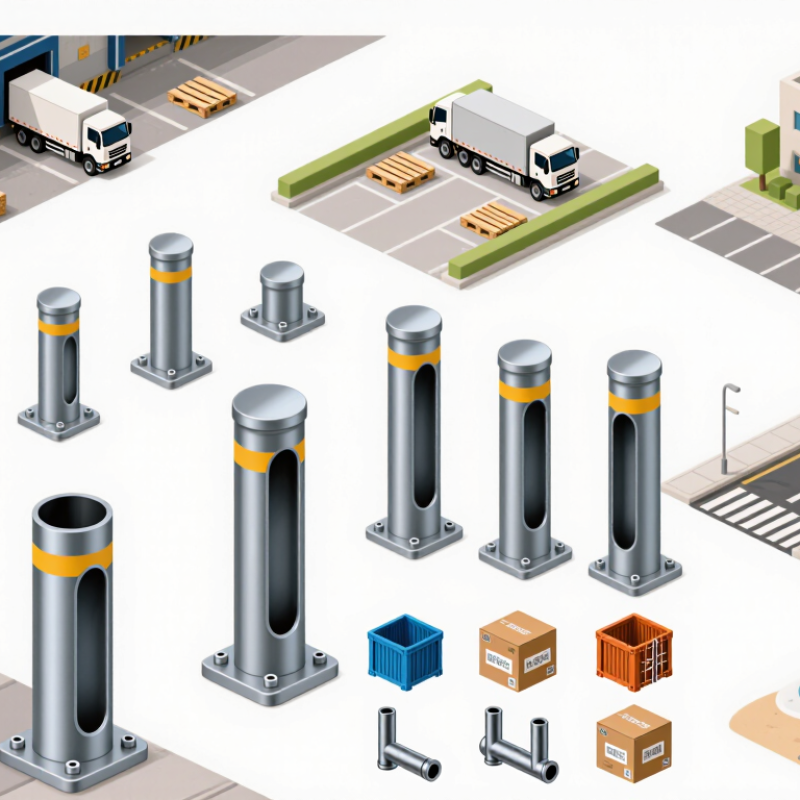
Steel parking bollards are short, fixed posts that create a visible boundary between vehicle routes and protected areas. Steel models may be surface-mounted or set into concrete, depending on the site and expected impact risk. Their job is practical: discourage shortcut parking, shield doorways, and help keep cars away from pedestrians, windows, and equipment. Placement matters. A post outside a shop entrance can guide a driver’s path, while a poorly spaced row may leave a vehicle-sized gap.
Strength varies. Wall thickness, diameter, anchoring, foundation depth, and steel grade all affect performance. For impact-rated products, ASTM F3016/F3016M describes testing for vehicle-mitigation devices at low speeds; a rating applies to tested conditions, not every real-world crash. NHTSA’s Traffic Safety Facts: 2022 Data reports 7,522 pedestrian deaths that year. That national figure is not specific to parking lots, but it underscores why separating people from moving vehicles deserves careful planning. A bollard is not a cure-all.
For a site assessment, measure turning paths, walking routes, delivery access, and the distance between posts. Check whether the concrete base can resist the loads the installation is meant to handle. A bright finish improves visibility in rain or at dusk, but paint can chip and needs upkeep. There is a trade-off: stronger protection may obstruct access or complicate maintenance. The right layout depends on actual traffic, not just appearance. One gap can matter.

Main Types of Steel Bollards Available Worldwide
Steel parking bollards generally fall into fixed, removable, retractable, and fold-down types. Fixed bollards are anchored into concrete and suit entrances or parking bays needing consistent separation. Their strength depends on more than steel thickness; foundation depth and installation quality matter too. A poorly set post can wobble.
Removable bollards lift out of a ground socket, leaving a clear route when access is needed. They work well for shared driveways, but the socket needs regular cleaning. Grit and rainwater can make removal difficult. Small details matter. Retractable bollards lower into a housing below ground, either manually or with a powered mechanism. They offer a clear surface when lowered, though the housing requires suitable drainage and maintenance.
Fold-down bollards pivot close to the ground and can be locked upright, making them practical for reserved spaces or private parking areas. Surface-mounted models may be considered where excavation is limited, but the pavement and anchors must suit the expected impact and daily use. Galvanized steel can help resist corrosion, while stainless steel is often chosen for exposed or visually sensitive settings. Neither finish removes the need for inspection. Choosing a type is not always obvious: traffic frequency, available space, ground conditions, and maintenance capacity all deserve attention.
Illustrative common nominal bollard diameters by configuration. Actual dimensions vary by manufacturer, site requirements, and the selected pipe or post specification.
Fixed, removable, and retractable bollards are commonly specified in larger diameters for access control and vehicle protection. Decorative and surface-mounted models are also available in a range of sizes; confirm the required dimensions and performance with project specifications.
When comparing steel parking bollards for sale worldwide, start with the steel itself. Carbon steel is common and strong, but wall thickness and internal reinforcement affect how it performs under impact. Stainless steel can resist corrosion well, though its cost may be harder to justify in ordinary parking areas. Ask for material specifications, not just a general claim of “heavy duty.” Small details matter.
Coatings must suit the site. Hot-dip galvanizing helps protect steel where rain, road salt, or frequent washing are expected. A powder-coated finish adds color and another protective layer, but chipped coating can expose the steel beneath. Check how edges, welds, and mounting plates are treated; these spots are easy to overlook. I have seen a polished finish draw attention while the installation details received less thought.
Security ratings need careful reading. A tested impact rating can help compare models, but it applies to defined test conditions, not every vehicle or installation. Review the test report, impact speed, vehicle mass, foundation requirements, and bollard spacing. Fixed, removable, and retractable designs may offer different levels of resistance. A rating without installation guidance is incomplete. Consider the ground, too: weak concrete can undermine an otherwise robust bollard. Verify documentation with the supplier, and match the specification to the actual site risk rather than choosing by appearance alone.
Compare common steel bollard configurations by material, finish, use, and security documentation. Dimensions and applications below are indicative; confirm exact specifications, installation details, and local requirements with the supplier.
| Bollard configuration | Typical material | Common finish or coating | Indicative size range | Typical use | Security rating to compare | Key purchasing checks |
|---|---|---|---|---|---|---|
| Fixed, surface-mounted | Carbon steel tube or fabricated steel | Hot-dip galvanizing; optional powder coating over the galvanized layer | About 100–200 mm outside diameter; height selected for the site | Parking bays, walkways, storefront edges, and light vehicle guidance | Usually unrated for vehicle impact unless the complete installation has been tested | Check base plate and anchor specifications, substrate condition, corrosion protection, and whether the intended impact performance is documented. |
| Fixed, embedded | Carbon steel tube, often with a below-ground section or concrete foundation | Hot-dip galvanizing; optional durable exterior coating for visibility or site appearance | About 100–200 mm outside diameter; above-ground height and embedment depend on the design | Perimeter protection and vehicle access control where excavation is possible | No inherent crash rating; impact performance depends on the bollard, foundation, soil, and installation | Confirm foundation design, drainage, underground utilities, finished height, and whether the claimed rating covers the installed system. |
| Removable, socket-mounted | Carbon steel post with a ground socket and locking or retention mechanism | Hot-dip galvanized steel; optional powder-coated finish | Commonly around 100–150 mm outside diameter; height varies by application | Occasional vehicle access through pedestrian areas, service lanes, or emergency routes | Typically unrated unless the specific post-and-socket assembly has a published impact test | Compare socket cover, locking method, removal effort, water and debris management, and the security of the post when installed. |
| Retractable or rising bollard | Steel rising section with a below-ground housing; drive components vary by model | Coated or galvanized steel housing and post; stainless-steel components may be used in exposed areas | Above-ground height and post diameter vary substantially by system | Controlled vehicle entrances requiring regular opening and closing | Check for a test report for the exact model and installation; powered operation alone is not a security rating | Review duty cycle, operating speed, emergency lowering, power-loss behavior, drainage, maintenance access, and foundation requirements. |
| Fixed stainless-steel bollard | Stainless steel, commonly grade 304 or 316 | Brushed or polished finish; appropriate cleaning and passivation may be specified | Commonly around 100–200 mm outside diameter; height varies | Architectural settings and sites where appearance and corrosion resistance are priorities | Material grade does not establish an impact rating; request system-level test evidence if vehicle resistance is required | Match the stainless grade to the exposure: 316 is generally more suitable than 304 for chloride-rich marine environments, but detailing and maintenance still matter. |
| Crash-tested fixed bollard system | Engineered steel bollard and specified foundation or installation assembly | Finish is project-specific; corrosion protection must not compromise tested construction | Use the exact dimensions and installation configuration stated in the test documentation | Sites with a defined hostile-vehicle mitigation or vehicle-impact requirement | Compare applicable test standards such as ASTM F2656/F2656M, IWA 14-1, or PAS 68, including the exact test classification and penetration result | Verify the full test report, vehicle and test conditions, penetration measurement, foundation details, spacing, ground conditions, and any limitations on installation. |
Important: A material, coating, diameter, or product description by itself does not demonstrate crash performance. Impact ratings apply to the tested configuration and installation; standards and classifications are not automatically interchangeable.
A parking bollard should fit the site’s actual risks, not just its appearance. Map vehicle entrances, pedestrian paths, loading areas, and tight turning points before selecting fixed, removable, or retractable units. Measure twice. Steel wall thickness, post diameter, and foundation depth all affect resistance; a heavy post can still fail if its footing is shallow or poorly anchored. Ask suppliers for material specifications and installation details, not just a product photo.
Keep people moving safely around the barrier. The 2010 ADA Standards for Accessible Design specify a 36-inch minimum clear width for accessible routes under Section 403.5.1. Measure this space after installation, including near parked vehicles and door swings. ASTM F2656/F2656M provides vehicle-impact test classifications and penetration measurements for tested barriers. Match documented test performance to the site’s assessed exposure; a decorative bollard is not automatically a security barrier.
Consider the setting, too. Coastal air, road salt, and frequent washing can accelerate corrosion, so compare steel grade, coating system, drainage, and maintenance needs. Check whether snowplows, delivery trucks, or emergency access require removable posts. A site walk may reveal awkward turning movements that drawings miss. That detail is easy to overlook. Revisit spacing after installation, because real traffic rarely follows a perfect plan.
Global purchasing starts with the site, not the catalogue. World Steel Association reported 1.89 billion tonnes of crude steel production in 2023. That scale does not guarantee consistent bollard wall thickness, weld quality, or coating performance. Ask suppliers for material grades, dimensional tolerances, coating specifications, and inspection records. Compare landed cost, including freight, customs handling, replacement parts, and lead times. A low unit price can become expensive when a damaged bollard must travel across oceans. Request samples or independent inspection for large orders.
Installation conditions vary sharply between sites. Confirm vehicle approach paths, underground utilities, soil strength, drainage, and local frost depth before choosing embedded or surface-mounted units. A polished specification is not proof of a sound installation; drawings can miss a buried cable or a tight turning radius. The NACE International IMPACT study estimated corrosion costs at US$2.5 trillion annually, about 3.4% of global GDP. The estimate covers many industries, but it underscores why coating selection and upkeep matter. Salt, standing water, and chipped finishes accelerate deterioration. Record each bollard’s location and installation details, then inspect for loose anchors, impact damage, rust, and blocked drainage. Inspect more often in coastal or heavily salted environments. Maintenance intervals should reflect actual exposure, not habit.
Whether you’re looking for fire-rated walls, doors, openings, floors or a specialty service, we have the solution for you. With over 40 years of experience in testing, innovating, and providing technologically advanced fire-rated glass and framing products, we deliver unyielding performance and quality at a competitive price.
