- Proudly Made in the USA
An Industrial Mixing Machine combines ingredients to create a more uniform product, but its purpose extends beyond simply stirring. In food plants, it can disperse cocoa into liquid or blend dry ingredients for consistent batches. In chemical and cosmetic production, it may help dissolve solids, form emulsions, or distribute pigments. The right machine depends on the materials, the desired result, and the process conditions.
Mixing specialist Suzanne M. Kresta, co-editor of Handbook of Industrial Mixing, has helped shape engineering understanding of industrial mixing. A practical paraphrase of a principle reflected in that work is: “Good mixing serves the process, not the machine.” That distinction matters. A mixer that works well for a thin liquid may struggle with a thick paste or delicate particles. Blade shape, speed, vessel design, and batch size all influence performance. Small changes can matter.
This guide explains what industrial mixers do, where different designs are used, and how to assess them for a production task. It also considers practical details: powder clinging to a vessel wall, uneven color in a batch, or heat building during prolonged mixing. These are not minor annoyances; they can signal that the equipment or settings need review. That sounds straightforward. It is not always. Real materials behave unpredictably, and no single machine suits every process. A careful selection starts with the product, not a brochure.
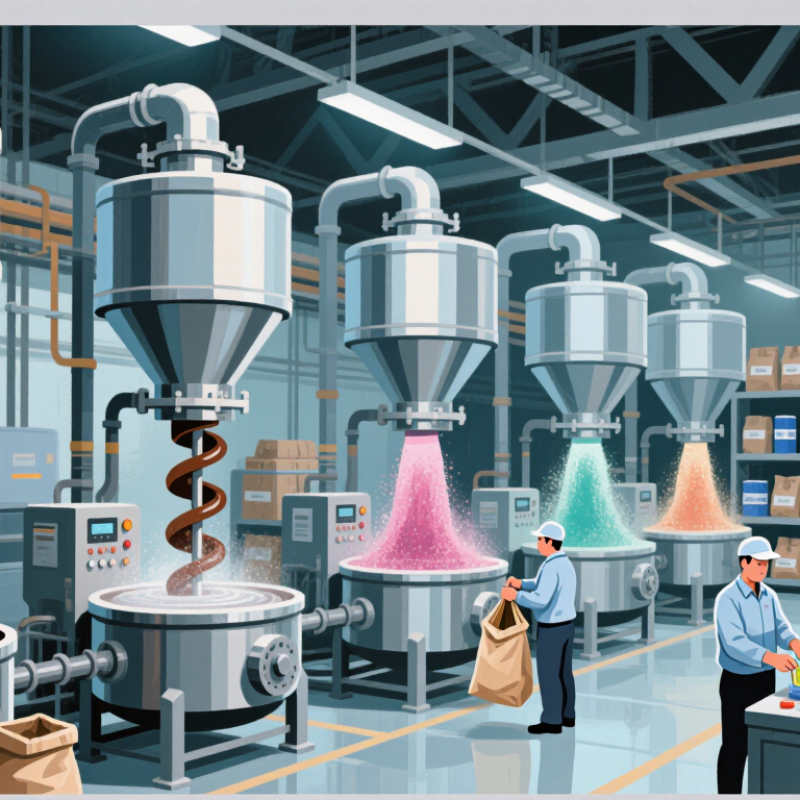
Industrial mixing machines combine liquids, powders, pastes, or granules into a more consistent batch. Typical components include a vessel, mixing element, shaft, drive system, and discharge point. The vessel’s shape and internal baffles guide circulation and help limit stagnant zones. Small details matter. A poorly positioned inlet can leave dry pockets, even when the motor sounds powerful. Operators should also check seals and shaft alignment; wear can affect performance and maintenance needs.
The drive system supplies the motion. An electric motor may connect through a gearbox, belt, or direct coupling, depending on the machine design. Gearboxes can reduce speed while increasing torque, which is useful for thick mixtures. Variable-speed controls let operators adjust the mixing action as materials change. More speed is not always better. Excessive agitation may introduce air, create heat, or stress delicate ingredients. The right setting depends on batch size, viscosity, and the result required.
Mixing relies mainly on three principles: bulk movement, shear, and molecular diffusion. An impeller moves material around the vessel, while shear helps break apart clumps or droplets. Diffusion gradually evens out small concentration differences. In practice, these actions overlap. A blend may look uniform near the surface but remain uneven at the bottom, so sampling from different points can reveal problems. Even then, one test cannot capture every batch variation.

An industrial mixing machine blends liquids, suspends solids, or helps transfer heat through a tank. Engineers often classify its flow using the Reynolds number: Re = ρND²/μ, where density, impeller speed, impeller diameter, and viscosity shape the result. The Handbook of Industrial Mixing: Science and Practice (Wiley, 2004) describes common stirred-tank guidance: laminar flow below Re 10, transitional flow from roughly 10 to 10,000, and turbulent flow above 10,000. Not a hard wall. Tank geometry and impeller design can shift real-world behavior.
Below Re 10, thick syrup may move in smooth layers around a slow impeller, with little exchange between distant zones. At higher Reynolds numbers, stronger circulation and eddies can improve blending, though they do not guarantee uniformity. The same handbook relates impeller power to Reynolds number, showing why power demand changes across flow regimes. A practical check is to record viscosity at the actual process temperature; small temperature shifts can change Re sharply. These thresholds are useful, but treating them as exact promises would be a mistake. Verify mixing time and sample consistency in the actual vessel.
An industrial mixing machine combines ingredients to achieve a consistent blend, texture, or temperature. The right design depends partly on whether material is processed in batches or flows continuously. That choice affects capacity, residence time, and process control. It also changes how operators clean equipment and respond to variations in incoming materials.
A batch mixer handles a defined quantity in a vessel. Operators load ingredients, mix them for a set period, then discharge the batch. This arrangement suits products that change often or require closely tracked recipes. A sight glass may reveal powder clinging to the wall, while a temperature probe helps monitor heat-sensitive mixtures. Batch sizes are easy to adjust, but each loading and cleaning cycle reduces production time. Small details matter.
A continuous mixer receives and discharges material while running. It can support steady, high-volume production when feed rates and ingredient properties remain reasonably consistent. Residence time—the time material spends inside the mixer—must be controlled through factors such as flow rate, equipment geometry, and mixing intensity. Too little time can leave streaks or dry pockets; excessive mixing may affect texture or temperature. Continuous systems can use sensors and automated adjustments, yet they need careful setup and regular checks. Real materials are rarely perfectly uniform, so process settings may need revision after production begins.
What Is an Industrial Mixing Machine Used For?
Industrial mixing machines combine materials until their composition, texture, or concentration suits a specific process. The right mixer depends on viscosity, batch size, temperature, and required uniformity. Small details matter. Impeller shape and operating speed can change how quickly ingredients disperse, and whether sensitive materials are damaged.
In chemical production, mixers blend liquids, dissolve powders, and disperse pigments or additives. Some processes need vigorous shear; others require gentle circulation to limit heat or foam. Equipment materials must also suit the chemicals being handled. In food processing, mixers combine ingredients for sauces, batters, and fillings, or help form stable emulsions. Cleanable surfaces and controlled mixing times support consistent batches, though recipes can behave differently at larger production scales.
Pharmaceutical manufacturing uses mixing to distribute active ingredients evenly through liquids, suspensions, or creams. Process controls and testing help verify uniformity; a mixer alone cannot guarantee it. Water treatment facilities use rapid mixing to disperse treatment chemicals, then slower agitation to help suspended particles gather into larger flocs. Too much or too little agitation may reduce effectiveness. A machine can still be poorly matched to the job, so operators need to assess the material and process conditions before choosing equipment.
Mixers blend ingredients, disperse solids, form emulsions, and help control reactions across industries.
The bars count representative applications listed for each sector. They are illustrative examples, not measurements of industry size or usage frequency.
An industrial mixer blends, disperses, dissolves, or maintains uniformity in a process batch. The right design depends on how the material flows and how sensitive it is to mechanical force. Low-viscosity liquids often suit impellers that circulate fluid through the vessel. Thick pastes may need anchors or helical elements that move material from the wall toward the center. For shear-sensitive products, gentler agitation can help protect texture and prevent unwanted heating. Small details matter.
Production scale changes the choice, too. A mixer that works in a bench vessel may leave dead zones in a large tank, where circulation paths and heat transfer differ. The U.S. Department of Energy’s 2014 sourcebook, Improving Motor and Drive System Performance, estimates that motor systems use about 68% of electricity in U.S. manufacturing. That figure covers many applications, not mixers alone, but it underlines why motor sizing and operating time deserve attention. Real batches are rarely textbook-perfect; test the actual material where possible.
Tips: Record viscosity, batch size, target mixing time, and shear limits before comparing equipment. Ask for a trial with your material, and inspect samples from several points in the vessel.
Whether you’re looking for fire-rated walls, doors, openings, floors or a specialty service, we have the solution for you. With over 40 years of experience in testing, innovating, and providing technologically advanced fire-rated glass and framing products, we deliver unyielding performance and quality at a competitive price.
