| What qualifies as a dinosaur fossil? | A preserved body part, trace, or impression of a dinosaur, including bones, teeth, eggs, skin impressions, footprints, and coprolites. | Provides direct evidence of dinosaur anatomy, behavior, diet, reproduction, and movement. |
| Geological age | Most dinosaur fossils date from the Mesozoic Era, approximately 252 to 66 million years ago. | Places dinosaur evolution within the Triassic, Jurassic, and Cretaceous periods. |
| Primary fossil-bearing rocks | Dinosaur remains are most often found in sedimentary rocks such as sandstone, mudstone, and siltstone. | Sedimentary environments can bury remains rapidly and preserve them through geological time. |
| Fossilization process | Minerals may gradually replace or fill the original hard tissues, while surrounding sediment becomes rock. | Explains why many fossils preserve shape and structure even when the original biological material is gone. |
| Common fossil types | Bone and tooth fossils, trackways, nests, eggshells, coprolites, and impressions of skin or feathers. | Different fossil types answer different questions about body structure, locomotion, feeding, and reproduction. |
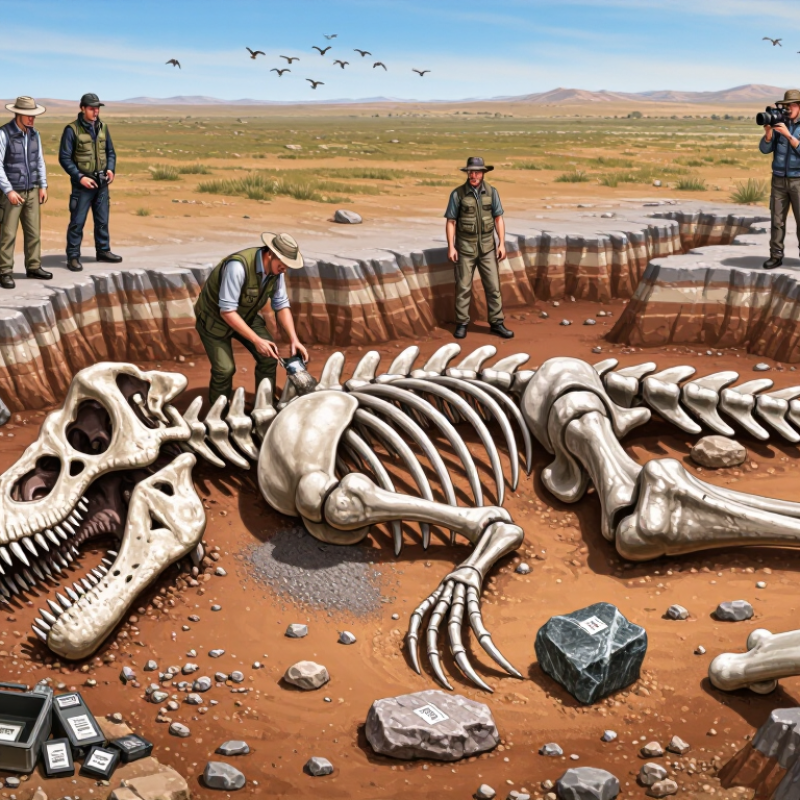
| Site discovery | Researchers identify exposed fossil-bearing strata through geological mapping, aerial imagery, field surveys, and local observations. | Connects fossils to their original geological setting and improves interpretation of ancient habitats. |
| Field excavation | Teams carefully expose specimens using tools such as brushes, awls, chisels, and controlled mechanical equipment when appropriate. | Reduces damage and preserves the position of bones and nearby geological evidence. |
| Documentation during collection | Collectors record coordinates, stratigraphic level, orientation, surrounding rock, photographs, sketches, and specimen numbers. | Preserves the scientific context needed to interpret and verify the fossil later. |
| Laboratory preparation | Rock is removed mechanically or with carefully selected chemical methods, and fragile specimens may receive stabilizing treatments. | Reveals anatomical details while protecting the specimen for study and storage. |
| Dating methods | Relative dating uses rock layers and fossils, while radiometric dating can measure suitable volcanic minerals associated with the fossil-bearing strata. | Establishes when the dinosaur lived and helps compare evolutionary events across regions. |
| Identification and classification | Scientists compare anatomy, measurements, growth patterns, and evolutionary features with previously described material. | Determines whether a specimen belongs to a known species or represents a potentially new taxon. |
| Digital and non-destructive analysis | CT scanning, three-dimensional imaging, microscopy, and chemical analysis can examine internal structure without extensive damage. | Supports virtual reconstruction, internal anatomy studies, and collaborative research. |
| Legal and ethical sourcing | Responsible collection follows land ownership rules, fossil protection laws, permits, export controls, and professional documentation standards. | Helps preserve scientific provenance and prevents important specimens from being removed or traded unlawfully. |
| Curatorial preservation | Specimens are stabilized, catalogued, stored under controlled conditions, and made available for qualified research and education. | Ensures that fossils remain accessible as long-term scientific records. |
| Main scientific importance | Dinosaur fossils reveal changes in biodiversity, body form, ecosystems, climate responses, extinction, and the evolution of birds. | They provide evidence for reconstructing approximately 180 million years of dinosaur history before the end-Cretaceous extinction. |