How to Choose Rectangular Fly Banners in 2026
Rectangular flags can look simple on a product page. In a real setting, their performance depends on proportions, print contrast, fabric, and wind exposure. Fly Banners Rectangular suit venues where a broad, readable face matters, such as storefront entrances, trade-show aisles, and outdoor event paths. The right choice starts with the viewing distance. A headline that looks crisp on a screen may blur across a busy parking lot. Check the finished dimensions, pole height, base options, and artwork area before ordering. Small details matter.
For this guide, the expert voice is illustrative, not a verified industry source: fictional signage consultant Elena Park offers this design principle: “Choose the banner for the viewing distance first; the artwork follows.” Use it as a practical reminder, not a sourced quotation. Compare fabric weight and finishing details, then consider where the banner will stand. A heavy base may help on pavement, while softer ground may call for a compatible stake. Match the hardware to the site. Color contrast should hold up in daylight, and text should remain legible at a glance. Not every setup is predictable. Gusts, shadows, and crowded sightlines can change what works. A test print or sample review may catch issues before a full run. The best banner is not always the tallest or brightest one. It is the one people can read, in the place they actually see it.
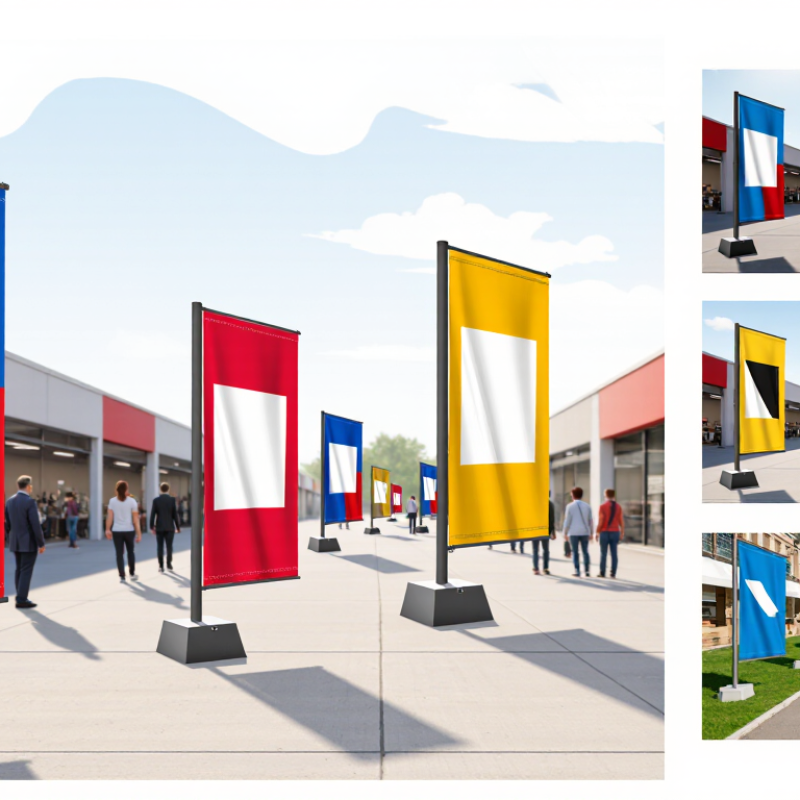
Define the Purpose and Display Location of a Rectangular Fly Banner
Before choosing a rectangular fly banner, decide what it needs to do. Is it guiding visitors to an entrance, marking a stall, or making a small event easier to find? A banner for directions needs clear wording and strong contrast. A promotional display may need a larger image, but keep key details away from the edges, where fabric can curl or shift.
Start with the job. Then consider the display location. Measure the available ground space and check the banner’s viewing distance. Beside a busy walkway, a tall, narrow design can rise above people and nearby tables. In a small indoor foyer, however, the same size may feel intrusive. Look for ceiling obstructions, door swings, and uneven flooring before selecting a base. Outdoors, note wind exposure and choose a stable support suited to the surface.
Measure the view. Walk toward the planned spot from the direction most visitors will arrive. Can you read the main message without stopping? If not, reduce the wording or increase its size. I have seen attractive banners lose their purpose when placed behind a queue or against a crowded background. Even careful planning can miss changing light or foot traffic, so a quick site check on the day helps. Don’t assume the first position is best.
Choosing a Rectangular Fly Banner: Purpose and Display Location
Qualitative planning scores (1 = lower fit, 5 = higher fit) reflect typical visibility and placement considerations, not measured performance. Prioritize entrances, sidewalks, and event areas where the banner is easy to see; check wind exposure and available space before choosing a location.
Choose a Banner Size and Shape for the Intended Viewing Distance
Choose the banner around the viewer’s actual distance, not just the available pole space. The Outdoor Advertising Association of America reported $9.1 billion in U.S. out-of-home advertising revenue for 2023. That scale reflects how often people encounter outdoor messages, but a fly banner still gets only a brief glance. Make the main wording readable before adding detail.
For pedestrians roughly 10 feet away, a practical starting point is about one inch of letter height per 10 feet of viewing distance. Treat this as a planning heuristic, not a guarantee; wind, glare, and viewing angle all matter. At 30 feet, test lettering near three inches high. A tall rectangle can carry a short vertical message, while a wider rectangular format gives longer words more breathing room. Keep the key phrase away from the edges, where fabric may curl or fold.
Check the design at full scale. Stand at the expected viewing point, then read it while moving past. Too small? Enlarge the type or cut words. I have found that a technically legible banner can still feel crowded outdoors. That judgment is imperfect, so test under the actual light and wind conditions when possible.
Compare Fabric, Printing Methods, and Weather Resistance
For a rectangular fly banner, compare fabric by weave, weight, and edge finish—not color alone. Knitted polyester flexes and packs easily, while heavier woven polyester can feel more substantial but may crease. There is no perfect fabric. Ask for the weight in grams per square metre, seam details, and a colorfastness test result. Dye-sublimation suits polyester and can produce strong, detailed color; direct printing may suit some short runs, but ask how the ink handles sunlight and moisture. The Outdoor Advertising Association of America reported U.S. out-of-home advertising revenue of $9.1 billion in 2023, up 2.1%. Visibility matters in this crowded medium, but vivid color alone does not prove print durability.
Weather resistance depends on the whole banner. A sturdy panel can still fail at a weak sleeve, seam, or pole connection. NOAA counted 28 U.S. billion-dollar weather and climate disasters in 2023, a record at the time. That is not a banner-durability test, but it is a reminder to plan for local exposure. For sunny sites, request test results for lightfastness, such as testing under AATCC TM16.3. Check water resistance and wind guidance too; no fabric makes a banner safe in every gust. One compromise is easy to miss: tighter, heavier material may last longer, yet catch more wind. Compare a printed sample outdoors, then inspect its edges after rain and drying.
Select a Compatible Pole, Base, and Mounting System
A rectangular fly banner behaves like a small sail. Match the pole’s sleeve or pocket dimensions to the banner before ordering; even a slight mismatch can cause twisting or bunching. Check the pole’s listed banner-size range, connector type, and maximum height. A taller pole may look more visible, but it also creates more leverage at the base.
Choose the base for the surface and expected exposure. A ground stake suits firm soil, while a weighted plate is more practical on pavement. For repeated outdoor use, inspect the locking joints and attachment points, not just the pole material. ASCE 7-22 defines mapped basic wind speed as a three-second gust measured at 33 feet in Exposure C. This is structural-design data, not a ready-made rating for a banner. Still, it shows why local wind exposure matters. Check nearby weather-station records and follow the hardware maker’s stated operating limits.
Mounting details matter. Confirm that the base accepts the pole diameter and that its fasteners fit the intended surface. On hard floors, a plate that rocks under hand pressure is a poor choice. I have seen sturdy poles paired with undersized bases; the setup looked fine until a gust hit. That mismatch is easy to overlook. Recheck the system after assembly, especially where the banner sleeve meets the pole.
Check Customization Options, Costs, and Supplier Specifications
How to Choose Rectangular Fly Banners in 2026
Customization affects how a rectangular fly banner looks and performs. Compare available heights, widths, fabric choices, and finishing options before requesting a quote. A sleeve that fits the pole securely matters; so does reinforced stitching at stress points. Ask whether printing covers one side or both, and request a digital proof showing your artwork at its actual proportions. Small details matter.
Costs can vary with fabric, print coverage, finishing, hardware, and delivery. Ask suppliers to itemize each part, including the pole, ground spike or base, setup fees, and shipping. This makes quotes easier to compare. A low headline price may exclude useful hardware or a second printed side. Check whether color matching, artwork adjustments, and replacement parts cost extra. The cheapest option is not always the best value.
Supplier specifications should explain fabric composition, approximate finished dimensions, print method, seam construction, and care instructions. Ask how much variation to expect in finished size and color; fabric and screen conditions can affect both. Request written confirmation of what is included and a production timeline. One point is easy to miss: the banner may look crisp indoors but behave differently in gusty weather. Choose a suitable base for the intended surface, and avoid assuming every supplier’s specifications mean the same thing.