- Proudly Made in the USA

How to Choose LED Tri Proof Lights for Global Sourcing?
Choosing an LED Tri-Proof Light for global sourcing requires more than comparing prices and wattage. Buyers must examine protection, optical performance, electrical safety, installation methods, and supplier reliability. A fixture may look identical in photographs, yet perform differently in a humid warehouse or cold loading bay.
Dr. Jianzhong Jiao, a recognized LED lighting specialist, has said, “LED lighting quality depends on the whole system, not the LED chip alone.” This principle should guide every sourcing decision. Review the driver brand, thermal design, lens material, LED efficiency, power factor, color consistency, and expected lifetime. Check IP65 or IP66 protection, IK ratings, operating temperature, and resistance to chemicals when relevant. Ask for LM-79 reports, photometric files, test samples, and clear warranty terms. Regional requirements also differ. A product suitable for Europe may need different documentation for North America or the Middle East.
Do not trust a polished datasheet alone. Test the light.
A practical evaluation should include a sample installation, measured power consumption, light distribution, flicker performance, and connector durability. Inspect the factory’s quality controls, packaging, spare parts, and production capacity before placing a large order. Certifications matter, but certificates should match the exact model, driver, and manufacturing site. This detail is easy to miss. Cost calculations should include freight, replacement rates, customs documentation, and installation labor. The cheapest LED Tri-Proof Light may become expensive after early failures. Even experienced buyers can overlook one variable, especially when specifications appear complete. Careful questioning remains essential.
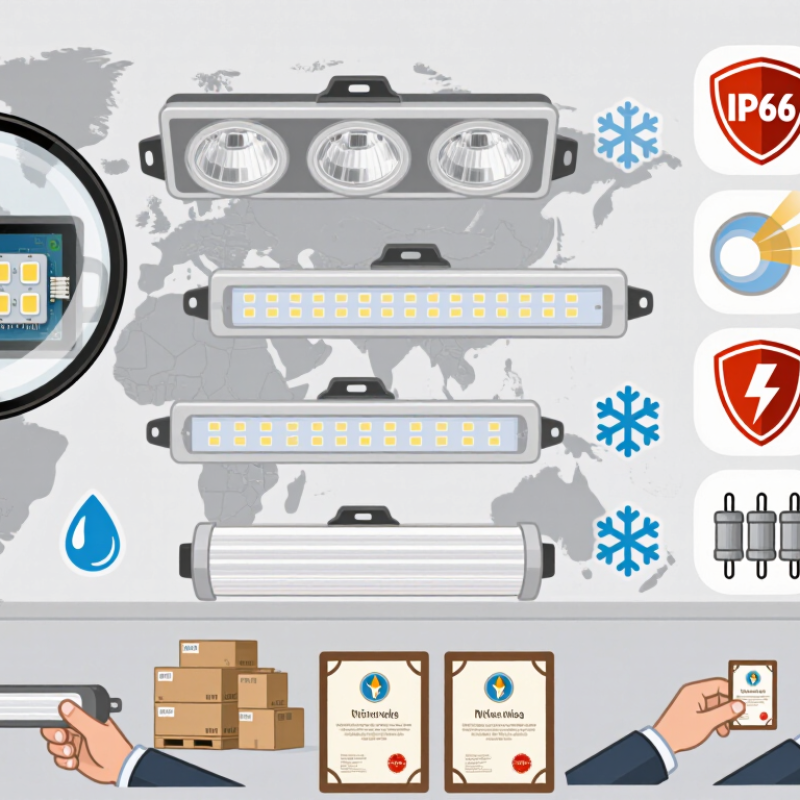
Table of Contents [Hide]
Define LED Tri-Proof Lights and Their Core Protection Features
LED tri-proof lights are sealed fixtures designed to resist water, dust, and physical impact. “Tri-proof” commonly refers to waterproof, dustproof, and corrosion-resistant construction. The term is useful, but it is not a universal performance standard. Buyers should verify test reports and protection ratings before comparing suppliers.
In practical inspections, IP65 or IP66 protection helps shield the enclosure from dust and water jets. IP67 may support temporary immersion, but it does not automatically improve every installation. Impact resistance, often shown by an IK rating, matters in warehouses and loading areas. A durable housing may use polycarbonate, aluminum, or coated steel. Silicone gaskets and secure end caps protect the internal driver and wiring. Small sealing gaps can cause early failure.
Global sourcing requires more than checking the housing. Confirm input voltage, operating temperature, lumen output, power factor, and emergency options. Ask for test records, material declarations, and installation instructions in clear English. Regional electrical requirements may differ. A supplier with traceable production records is easier to assess than one offering only attractive samples. Higher ratings are not always better; they can increase cost and complicate maintenance. I have seen buyers overlook condensation inside sealed fixtures. That detail deserves attention. Condensation happens. Suppliers should explain drainage design, thermal management, and warranty conditions before a purchase order is released.
How to Choose LED Tri Proof Lights for Global Sourcing? - Define LED Tri-Proof Lights and Their Core Protection Features
| Evaluation Dimension | Typical Data or Rating | What It Means | Global Sourcing Checkpoint |
|---|---|---|---|
| Product Definition | Integrated LED linear luminaire with a sealed housing | An LED tri-proof light is designed to resist dust, moisture, and common industrial exposure. “Tri-proof” is a market term rather than a standalone international certification. | Request the complete technical datasheet, installation instructions, and applicable test reports. |
| Ingress Protection | IP65, IP66, or IP67 according to IEC 60529 | The first digit indicates dust protection. The second digit indicates protection against water. IP65 resists water jets, IP66 resists powerful water jets, and IP67 allows temporary immersion under specified test conditions. | Match the rating to the site. Do not treat IP67 as proof of continuous underwater operation unless separately specified. |
| Impact Protection | IK08: 5 joules; IK10: 20 joules, according to IEC 62262 | The IK rating measures resistance of the enclosure to mechanical impact. A higher number generally indicates greater impact resistance. | Choose a higher IK rating for warehouses, workshops, parking areas, and locations exposed to tools or equipment. |
| Corrosion Resistance | Sealed polymer housing, coated metal parts, and stainless-steel fasteners where required | Corrosion resistance depends on the housing material, coatings, fasteners, gaskets, and the chemicals present at the installation site. | Ask for material specifications and chemical-resistance information instead of relying only on the term “tri-proof.” |
| Rated Power | Common commercial ranges: 20–80 W per luminaire | Power consumption affects illumination, circuit loading, operating cost, and thermal performance. | Verify actual input power, power factor, inrush current, and compatibility with the intended electrical circuit. |
| Luminous Efficacy | Approximately 100–160 lm/W for many current commercial products | Efficacy is the ratio of delivered luminous flux to input power. It should be evaluated at the complete luminaire level, not only at LED-chip level. | Request test conditions, delivered lumens, ambient temperature, and photometric files such as IES or LDT. |
| Color Temperature | Common choices: 3000 K, 4000 K, 5000 K, and 6500 K | Lower color temperatures appear warmer, while higher color temperatures appear cooler or more daylight-like. | Confirm the required CCT, tolerance, binning method, and consistency between production batches. |
| Color Rendering | CRI ≥80 for general industrial use; CRI ≥90 for higher color-accuracy requirements | CRI indicates how accurately colors are rendered compared with a reference light source. It does not directly measure brightness or energy efficiency. | Specify the minimum CRI and any special requirements for retail, inspection, healthcare, or food-processing areas. |
| Input Voltage | Typical wide-range input: 100–277 VAC or 100–347 VAC, depending on the model | A wide input range can support multiple electrical systems, but the exact allowable voltage and frequency remain product-specific. | Confirm local voltage, frequency, wiring method, dimming requirements, and surge protection before ordering. |
| Operating Temperature | Common product range: approximately −20°C to +45°C; specialized models may support wider ranges | Temperature limits affect LED output, driver reliability, gasket life, and overall service life. | Use the declared ambient-temperature rating, not the storage-temperature rating, for installation decisions. |
| LED Driver and Power Quality | Power factor ≥0.90 and total harmonic distortion ≤20% are common commercial targets | Driver performance influences flicker, electrical efficiency, compatibility with controls, and grid-side power quality. | Request power-factor, THD, flicker, surge, and dimming data measured under defined conditions. |
| Service Life | Common claim: L70 ≥50,000 hours | L70 is the estimated operating time until average luminous flux decreases to 70% of the initial value. It is not the same as complete failure time. | Check the test method, ambient temperature, driver life, warranty terms, and whether the claim applies to the complete luminaire. |
| Safety and Compliance | Applicable requirements may include IEC, EN, UL, CSA, CE, UKCA, or local regulations | Compliance depends on the destination market, product construction, voltage, installation method, and applicable legislation. | Define the destination countries first and verify certificates, declarations, markings, and report numbers with an accredited testing body where appropriate. |
| Installation and Maintenance | Surface-mount, suspension, chain-mount, through-wiring, and emergency options may be available | Mounting hardware, cable glands, connectors, and replacement procedures affect installation time and long-term protection. | Confirm mounting distance, cable entry, terminal type, wiring diagram, spare parts, and gasket replacement requirements. |
| Packaging and Logistics | Carton dimensions, net weight, gross weight, units per carton, and pallet configuration | Packaging data affects freight cost, container utilization, handling risk, and import documentation. | Obtain packed dimensions, HS classification support, country-of-origin details, and pre-shipment inspection criteria. |
Note: Ratings, performance values, and compliance requirements vary by model and destination market. Final purchasing decisions should be based on model-specific technical documents and verified test evidence.