China Top 10 Fire Rated Glass Door Suppliers
China’s fire rated glass doors industry serves commercial, industrial, hospitality, and public building projects worldwide. This guide introduces ten notable Chinese suppliers and explains what makes each company worth further review.
The selection considers manufacturing experience, product range, testing documentation, export history, and project support. It also examines door configurations, frame materials, glazing types, hardware options, and stated fire-resistance periods. A reliable supplier should provide clear technical data, product drawings, installation guidance, and traceable test reports. Certifications matter, but their validity and application scope require careful checking.
Details matter.
A showroom photograph cannot prove performance. Buyers should confirm whether the complete door assembly was tested, rather than the glass alone. They should also review testing standards required in the destination market. These may differ by country, building type, and project risk. Supplier communication offers another useful signal. Prompt answers, consistent specifications, and practical engineering advice often reveal stronger professional capability.
This ranking is not absolute. Company strengths can change with production capacity, management, or certification updates. Some suppliers may perform well on custom projects but offer limited standard inventory. Others may provide attractive pricing while requiring closer installation supervision. That is worth remembering.
The following overview aims to support informed comparison, not replace professional approval. Before ordering, buyers should request current certificates, sample specifications, warranty terms, and references from comparable installations. With careful verification, China’s leading manufacturers can offer dependable fire rated glass doors for demanding architectural applications.
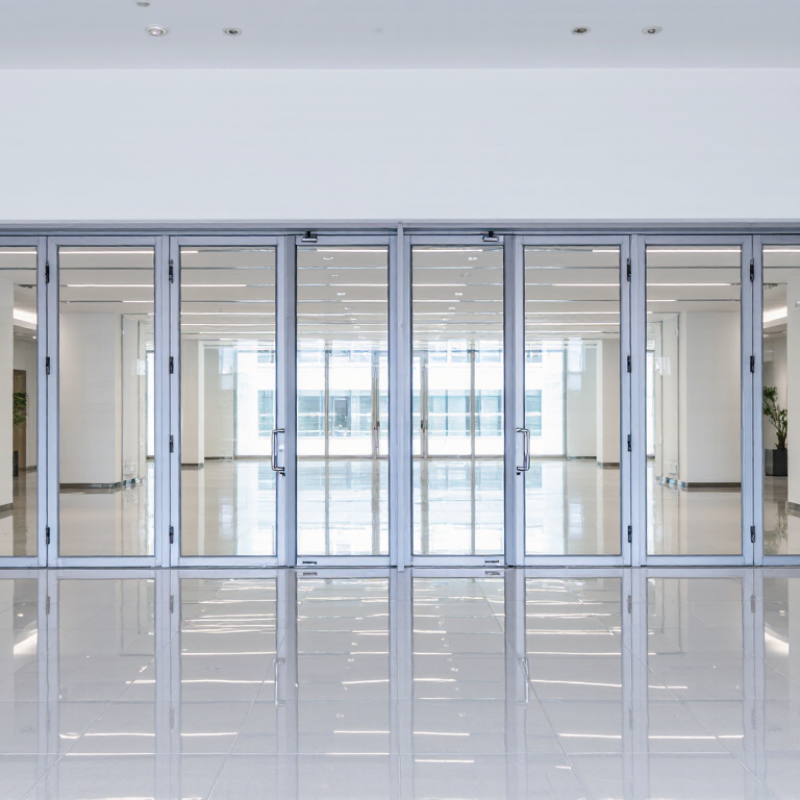
Fire-Rated Glass Door Classes: EI, EW, and E Ratings from 30 to 120 Minutes
When comparing China’s top 10 fire-rated glass door suppliers, begin with the rating, not the product photo.
E means integrity: the door resists flames and hot gases for a stated period.
EW adds limited radiation control, while EI provides both integrity and insulation.
The difference matters near escape routes, stairwells, and occupied rooms.
Fire ratings commonly range from 30 to 120 minutes. A 30-minute E door may suit a lower-risk internal partition, while an EI 120 assembly offers far stronger protection.
Yet the glass alone does not define performance. The frame, intumescent seals, hinges, locks, and installation method must match the tested system.
A 120-minute glass panel cannot automatically create a 120-minute door.
Look for clear classification reports, furnace test records, and installation instructions from each supplier. Check whether the rating applies to a single or double door, glazed size, opening direction, and hardware arrangement.
On site, small gaps around the frame can undermine an otherwise strong assembly. That detail is easy to overlook.
Even experienced buyers sometimes compare minutes without comparing test conditions.
A supplier should explain those limits plainly, provide traceable documentation, and support inspection before delivery. Prices may look attractive, but replacing an unsuitable door later is expensive and disruptive.
China’s Top 10 Fire-Rated Glass Door Suppliers and Their Core Products
China’s top ten fire-rated glass door suppliers serve different project needs, rather than offering identical product lines. One supplier specializes in single-leaf steel-framed fire glass doors for corridors and stairwells. Another produces double-leaf doors with panic hardware for busy public buildings. A third focuses on slim aluminum-framed systems with tested fire-resistant glazing. These products often combine tempered or laminated fire-rated glass, mineral cores, and smoke-control seals.
A fourth supplier develops oversized glazed doors for hotel lobbies and commercial atriums. A fifth provides stainless-steel framed doors for hospitals, laboratories, and clean areas. Another concentrates on acoustic fire doors, where glass thickness and interlayer design affect both sound control and fire performance. One manufacturer offers concealed-frame doors for architects seeking uninterrupted wall lines. A separate supplier produces fire-rated sliding doors, while another supplies automatic doors with monitored closing systems. The tenth commonly focuses on custom partitions, matching doors, sidelights, and transoms.
From practical specification work, the core product should never be judged by appearance alone. Buyers should request complete test reports, fire ratings, glass thickness, frame details, hardware data, and installation instructions. Door size matters greatly. A beautiful oversized panel may require stronger hinges and stricter deflection control.
Factory quality can still vary between batches. This is where factory audits, sample inspections, and independent verification become valuable. Some suppliers communicate clearly, but their technical drawings may need revision. That small weakness deserves attention before production begins.
Testing Frameworks: EN 1634-1, ISO 834, and GB 15763.1 Compliance
Selecting China’s top fire-rated glass door suppliers requires more than a catalogue claim. Testing frameworks reveal whether a complete doorset performs under heat, pressure, and installation stress. EN 1634-1 evaluates door and shutter assemblies for integrity and insulation during furnace exposure. ISO 834 defines the standard time-temperature curve. It reaches about 842°C after 30 minutes and 945°C after 60 minutes. This is a heating reference, not product approval. GB 15763.1 addresses fire-resistant safety glass used in buildings. Reports should identify glass thickness, interlayer, frame, hardware, dimensions, and test duration. Missing details weaken confidence.
The stakes are measurable. The National Fire Protection Association’s 2024 fire-loss report estimated 1,388,500 fires and about 22.1 billion dollars in property damage during 2023. These figures do not prove glass doors caused losses. They show why traceable testing matters. For supplier comparison, request the original laboratory report, furnace calibration records, classification basis, and installation limits. Check whether the tested doorset matches the proposed model. Small changes matter. A different closer, seal, glazing bead, or opening size can alter performance. I would verify Chinese test evidence against export-market requirements. Equivalence is often assumed too quickly. That is a weakness. Experienced reviewers inspect production controls, batch traceability, installation instructions, and independent surveillance. A polished certificate can still leave practical questions unanswered. Ask them.
China Fire-Rated Glass Door Suppliers — Testing Framework Reference
The chart shows the ISO 834 standard fire exposure temperature curve, calculated from
T = 20 + 345 log10(8t + 1), where t is time in minutes and
T is furnace temperature in °C. EN 1634-1 uses standardized fire-resistance testing
for doorsets and related assemblies, while GB 15763.1 addresses fire-resistant building glass.
Supplier certification should be verified against the specific product configuration, tested duration,
integrity, insulation, and applicable national or international test report.
Supplier Comparison: Glass Type, Door Ratings, Certifications, and Test Reports
China Top 10 Fire Rated Glass Door Suppliers
Comparing China’s leading fire-rated glass door suppliers requires more than checking price lists. Review the glass type first. Ceramic glass tolerates intense heat, while intumescent laminated glass can provide both fire resistance and improved insulation. Borosilicate glass offers strong thermal performance in selected applications. Ask whether the complete door assembly achieves E30, EI60, or EI90 performance. The rating must cover the glass, frame, seals, hinges, closer, and glazing method.
Certifications should match the destination market and project specification. Common references include EN 13501-2, BS 476, ASTM E119, and UL 10C. A reliable supplier should provide current certificates, laboratory details, test dates, and product identification. Read the test report carefully. It may apply only to one door size, frame material, or hardware arrangement. A high rating on paper can become irrelevant after an untested modification. This is where supplier experience matters.
Tips: Request a complete test report, not a certificate image. Confirm the accredited laboratory. Check traceability labels on delivered doors. Ask for installation drawings and approved hardware lists. Also compare lead time, packaging, replacement seals, and technical support. A small detail can delay approval.
Some comparisons remain imperfect. Suppliers may describe glass performance differently. Therefore, ask direct questions and record every technical promise in the quotation. Clear evidence is more valuable than impressive wording.
Selection Criteria: Five Checks for Performance, Traceability, and Installation Safety
Choosing among China’s top 10 fire-rated glass door suppliers requires more than comparing prices. Performance evidence should be the first practical filter. Ask for independent fire-test reports, rating duration, glass thickness, and tested door dimensions. Confirm that the complete assembly was tested, including glass, frame, seals, hinges, and closing hardware. A strong-looking door is not automatically a compliant door.
Traceability is the second check. Each panel should carry a readable production mark or batch record. Request certificates that match the actual shipment, not a generic sample. The third check is system compatibility. Glass, frame materials, intumescent seals, and hardware must belong to one tested configuration. Mixing components may weaken protection, even when every part appears certified. Small details matter.
Installation safety needs careful attention. The supplier should provide fixing drawings, approved tolerances, weight data, and handling instructions. On site, installers need suitable lifting equipment and protected storage. Scratched edges, distorted frames, or missing seals can create serious weaknesses. The fifth check is after-sales support: inspect replacement seals, maintenance guidance, inspection intervals, and response procedures. Ask who will answer technical questions after delivery. That answer reveals practical reliability.
I have seen projects delayed because a certificate covered a different frame design. That mistake was avoidable. Product documents can also contain unclear translations or missing revision dates. Treat those gaps seriously, while allowing room for clarification. A careful supplier welcomes questions and records changes in writing. Real confidence comes from matching documents, delivered products, and safe installation conditions.